How Cars, Neighborhoods, and Family Life Have Actually Changed
Emory Frye
September 8, 2026
The way families live has always been connected to the places and technologies around them. Change the car, and suddenly people can live farther from work. Build highways, and suburbs expand. Give every teenager a smartphone, and the neighborhood stops being the only place where friends can find each other.
Over the past several decades, cars, neighborhoods and family life have all changed together. Some changes brought enormous convenience and freedom. Others quietly removed everyday interactions that once seemed completely ordinary.
The result is that a modern family can live in a house that looks similar to one built 50 years ago while experiencing daily life in a completely different way.
Cars gave families a much bigger world
As car ownership expanded during the twentieth century, families were no longer limited to living close to workplaces, shops or public transportation.
The automobile made distance easier.
Families could move farther from city centers while parents commuted to work. Shopping centers, supermarkets and entertainment followed them. Weekend trips became easier, and visiting relatives no longer necessarily required trains or complicated travel arrangements.
Cars also changed what families considered nearby.
A grocery store several kilometers away could still feel convenient if the drive took ten minutes.
This freedom had consequences. Communities increasingly developed around roads and parking rather than walking. In many places, daily life became difficult without access to a car.
The automobile offered independence while simultaneously helping create places where driving became almost unavoidable.
The suburbs changed the shape of family life
Postwar suburban growth, particularly in the United States, created a powerful new image of family life.
A detached house, private yard and car in the driveway became symbols of stability and success.
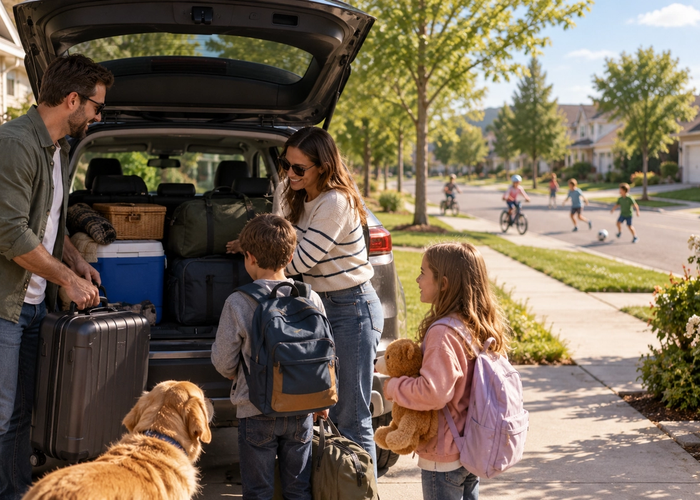
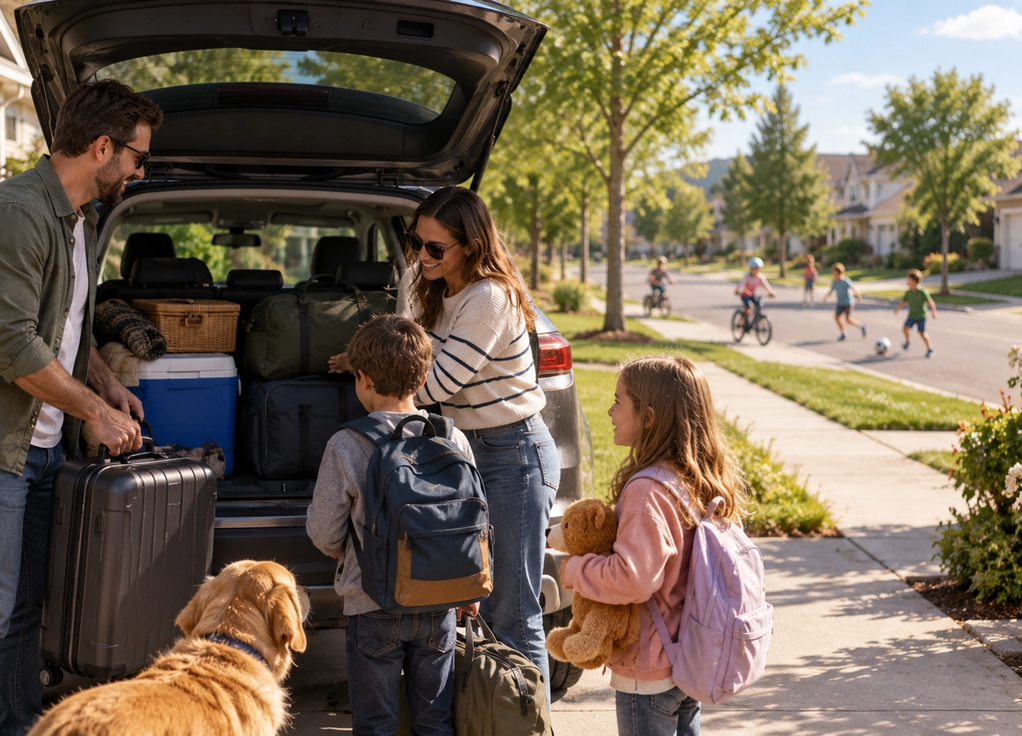
Neighborhoods were designed around families. Children attended nearby schools, played in yards and often knew many of the other children living on their street.
But the classic image of suburban life was never universal. Access to certain neighborhoods was shaped by income, race, discriminatory housing policies and other barriers.
Still, the suburban model had enormous influence.
It separated different parts of daily life geographically. Home might be in one place, work somewhere else and shopping in another.
The car connected everything.
Children once had a much larger roaming territory
One of the most noticeable changes in family life involves children’s independence.
In previous generations, it was relatively common for children to leave home, meet friends and spend hours outside without parents knowing exactly where they were.
They rode bicycles, walked to friends’ houses, played in parks and invented activities because there was not always an adult organizing one.
The instruction to “be home before dark” represented an entire parenting system.
Today, childhood is often more supervised and scheduled.
Parents drive children to sports, lessons, playdates and activities. Smartphones allow families to remain in constant contact. Location sharing can even show parents exactly where an older child is.
There are obvious advantages to being able to reach children quickly.
But it also means the experience of being temporarily unreachable has become increasingly rare.
The family car became an extension of the home
Cars themselves changed dramatically.
Earlier family cars were relatively simple machines. Over time they gained air conditioning, improved safety systems, entertainment features, navigation and eventually internet connectivity.
The family road trip changed along with them.
Children once brought books, toys and whatever games could be invented from objects passing outside the window. Families argued over maps and stopped to ask strangers for directions.
Later came portable cassette and CD players.
Then portable DVD players appeared.
Today, children can sit in the back seat with tablets, headphones and access to more entertainment than an entire household possessed a few decades ago.
Meanwhile, GPS tells the driver where to turn and smartphones locate restaurants, petrol stations and hotels.
Road trips became easier.
They also became much quieter.
Neighborhood life moved indoors and online
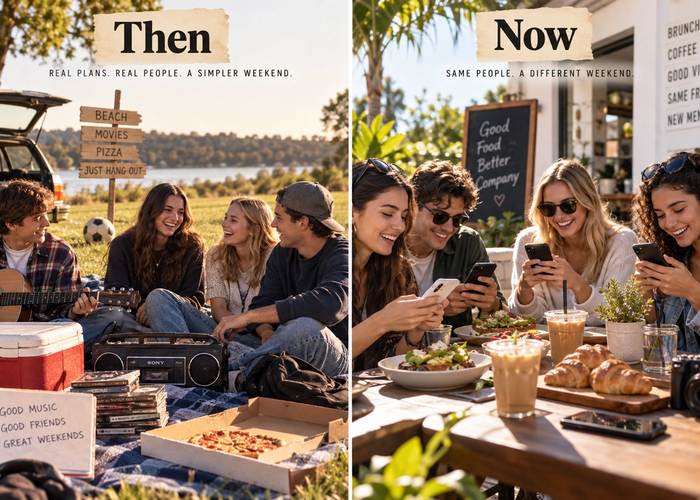
Neighborhoods once played a larger role in people’s social lives partly because there were fewer alternatives.
Children found friends by knocking on doors. Adults borrowed things from neighbors because ordering a replacement for next-day delivery was not an option. Local shops and community spaces created repeated encounters with the same people.
You did not necessarily choose everyone in your local social network.
Proximity chose some of them for you.
Modern communication changed that.
People can maintain close relationships with friends living across a city or on another continent. Online communities allow someone with an unusual hobby to find hundreds of people who share it instead of hoping one happens to live nearby.
That is an extraordinary expansion of social possibility.
But it also means physical neighbors can become less important.
It is entirely possible to know what a former classmate living 2,000 kilometers away ate for breakfast while having no idea what the person living three doors down is called.
Two-car households changed the daily routine
As more households had multiple cars and more women entered paid employment, family schedules became increasingly independent.
One parent no longer necessarily controlled the household’s only vehicle. Different adults could travel to different workplaces while children were transported between schools and activities.
That flexibility helped create another modern phenomenon: the family calendar.
Sports practice, appointments, lessons, meetings and social activities can turn ordinary weekdays into logistical operations.
Parents may spend significant amounts of time driving children between organized activities.
The car that once represented freedom from distance can sometimes make families feel as though they spend half their lives traveling between places.
Safety improved enormously
It is easy to become nostalgic about older cars until you look closely at their safety features.
Modern vehicles are dramatically more sophisticated in protecting occupants.
Seat belts became standard and their use increasingly mandatory. Airbags became widespread. Child car seats improved. Crumple zones, electronic stability control and advanced driver-assistance systems added layers of protection that earlier generations simply did not have.
Parents today may spend considerable time researching the safest child seat or family vehicle.
A few generations ago, children sometimes traveled with remarkably little restraint.
Some parts of the past are more enjoyable as memories than as safety standards.
Modern families gained freedom but also became more scheduled
The biggest change may be how carefully organized everyday life has become.
Cars allow families to travel enormous distances easily. Smartphones make coordination instant. Navigation removes uncertainty. Parents can contact children almost anywhere.
Yet all this convenience also makes complicated schedules possible.
A family can live far from work, send children to activities across town, maintain friendships across huge distances and coordinate everything through shared digital calendars.
Earlier family life was often more geographically limited.
Modern family life can be geographically enormous.
That does not automatically make one better than the other.
The neighborhood used to define more of our lives
Cars expanded the physical world available to families. The internet expanded it again.
A person’s job, friends, shopping, entertainment and community no longer need to exist anywhere near their home.
That is a remarkable form of freedom.
But it also explains why older stories of neighborhood life can feel so different. When children played with whoever lived nearby and adults repeatedly encountered the same people at local stores, geography created relationships automatically.
Today, relationships are much more likely to be chosen.
We gained access to a much bigger world.
The strange trade-off is that sometimes we know considerably less about the tiny world immediately outside our front door.