
What We’ve Actually Gained (And Lost) in the Last 50 Years
Mekhi Gross
September 9, 2026
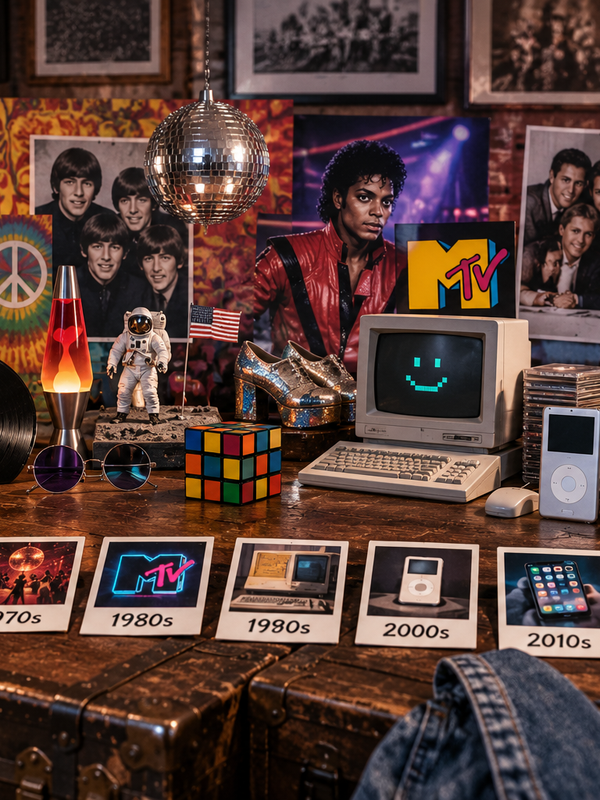
Fifty years ago, everyday life looked familiar enough that we would recognize it, but different enough that living there would require serious adjustment.
People drove to work, watched television, went shopping, raised families and complained about being busy. But there were no smartphones, no streaming services, no social media and no instant access to the world’s information. Long-distance communication was more difficult, medical treatments were less advanced and many things we now accomplish in seconds required considerable time and effort.
It is tempting to decide that life was either better then or better now. The reality is more interesting.
Over the last 50 years, we have gained extraordinary convenience, knowledge and freedom. At the same time, some of the friction technology removed had unexpected value.
We gained access to almost unlimited information
One of the most dramatic changes is how easily ordinary people can find information.
In the 1970s, answering a complicated question might require a library, encyclopedia, newspaper or knowledgeable person. Sometimes the answer simply remained unknown.
Today, a phone provides access to an astonishing amount of human knowledge.
You can learn how to repair a sink, understand a historical event, study another language or watch a university lecture without leaving home.
That access has made learning dramatically easier.
But unlimited information created a new problem.
Not everything online is accurate.
Instead of simply finding information, people now have to decide which information deserves to be trusted. The challenge moved from access to judgment.
We gained constant connection but lost being unreachable
Communication across distance has improved almost beyond recognition.
International calls that once felt expensive and special have been replaced by free messages and video calls. Families living on different continents can see each other every day.
That is an enormous gain.
But communication also became continuous.
Before mobile phones, leaving home meant becoming temporarily unavailable. Work colleagues could not easily reach you during dinner. Friends did not expect immediate responses while you were shopping.
Today, a person can be contacted almost anywhere.
That improves safety and coordination, but it also creates an expectation of availability.
We eliminated much of the anxiety of not being able to reach someone.
We also eliminated many of the moments when nobody could reach us.
We gained safer and more effective medicine
The advances in healthcare over the last 50 years are difficult to overstate.
Medical imaging improved dramatically. Treatments for many cancers advanced. Surgical techniques became less invasive. Survival after heart attacks improved, and medications became available for conditions that were once much harder to manage.
Premature babies now survive at stages that would have offered far fewer options decades ago.
Medical knowledge also became more accessible to patients.
People can learn about conditions, seek specialist opinions and communicate with healthcare providers more easily.
Not every development has been equally distributed, and healthcare remains expensive or inaccessible for many people.
But if you had to experience a serious medical emergency, there are very few reasons to prefer the technology of 1976 to the technology available today.
We gained safer cars but more car-dependent lives
Cars today are significantly more sophisticated than those families drove 50 years ago.
Seat belts, airbags, improved child restraints, crumple zones, electronic stability systems and other safety technologies have transformed vehicle protection.
Navigation has changed too.
Getting lost is increasingly difficult when a phone can continuously calculate the route.
Yet cars also helped reshape communities around driving.
In many places, homes became farther from workplaces, shops and schools. Families gained the freedom to travel greater distances but often became dependent on vehicles to accomplish basic daily tasks.
The car gave us mobility.
Sometimes it took walkability in exchange.
We gained entertainment on demand but lost anticipation
Entertainment once operated according to somebody else’s schedule.
Television programs aired at specific times. Movies had to be seen in theaters or later caught on television. Music was purchased on physical formats or heard on the radio.
Missing something meant waiting.
Streaming eliminated most of that inconvenience.
Today, enormous libraries of music, movies and television are available instantly. A person can watch an entire television season in one weekend or listen to almost any album ever recorded within seconds.
This is objectively more convenient.
But scarcity created anticipation.
Waiting a week for an episode gave people time to talk about it. Buying an album encouraged listeners to play songs repeatedly because that was what they had.
We gained access to everything.
Individual pieces of entertainment sometimes feel less like events because of it.
We gained choice but also decision fatigue
A supermarket 50 years ago offered fewer products than many supermarkets do today.
Television had fewer channels. Restaurants offered fewer cuisines in many towns. Shopping was limited largely to what local stores carried.
Modern consumers have far more choice.
Someone can order clothing from another country, watch foreign television, discover music from almost anywhere and have food from dozens of restaurants delivered home.
Choice creates freedom.
It also creates work.
Which television show should you watch when there are thousands? Which hotel should you book after reading 300 reviews? Which of the nearly identical products online is actually best?
Earlier generations sometimes had easier decisions because there simply were not many alternatives.
We gained social freedom
Some of the most important improvements of the last half-century have little to do with gadgets.
Opportunities and legal protections expanded for many groups that faced significant discrimination.
Women entered professions and leadership roles in much greater numbers. Social expectations around marriage and family became less rigid. LGBTQ+ people gained major legal rights and broader social acceptance in many places.
Racial discrimination obviously did not disappear, but legal and institutional barriers changed significantly.
The past can look attractive through fashion, music and photographs.
It becomes less romantic when we remember who had fewer choices about how they were allowed to live.
For many people, modern life offers freedoms that previous generations fought hard to obtain.
We gained convenience but lost everyday skills
Technology removed countless small tasks from daily life.
We no longer need to memorize phone numbers. GPS means fewer people need to navigate using maps. Automatic transmissions simplified driving. Online banking reduced the need to manage payments manually.
Most of these changes are useful.
But when technology handles a task consistently, the underlying skill can disappear.
Many people would struggle to navigate an unfamiliar city without a phone. Fewer people repair their own household objects. Mental arithmetic is less necessary when a calculator is always nearby.
Previous generations did not possess these skills because they were inherently wiser.
They had them because everyday life required them.
We gained documentation but lost some privacy
Fifty years ago, most ordinary moments disappeared.
A family might take photographs during birthdays, holidays and vacations, but daily life was rarely recorded.
Today, almost everyone carries a high-quality camera.
Children can grow up with thousands of photographs documenting their lives. Important moments can be shared immediately with relatives around the world.
But cameras are everywhere else too.
Security systems record streets and shops. People can film public encounters instantly. Social media encourages us to document ourselves voluntarily.
We gained an extraordinary visual record of modern life.
We also created a world in which being completely undocumented is increasingly unusual.
We gained convenience, but time didn’t become abundant
This may be the strangest outcome of all.
Technology saved enormous amounts of time.
Washing machines reduced household labor. Email replaced many letters. Online banking eliminated trips to branches. Search engines reduced hours of research. Shopping can happen without leaving home.
Yet people do not necessarily feel surrounded by free time.
Instead, expectations expanded.
Because communication is instant, replies are expected faster. Because work can happen anywhere, it can follow us home. Because information is always available, there is always something else to read or watch.
We became faster.
Then we filled the saved time.
Progress always comes with a trade-off
The last 50 years did not produce a simple story of decline or improvement.
We gained safer cars, better medicine, easier communication, broader social freedoms and access to more information than previous generations could have imagined.
We also became more distracted, more reachable and more dependent on systems that constantly compete for our attention.
Few people would genuinely choose to give up modern medicine, navigation or the ability to video call someone they love.
But we might occasionally want something the older world provided accidentally.
A little boredom.
A little privacy.
A little anticipation.
And perhaps a few hours when nobody expects us to answer anything at all.