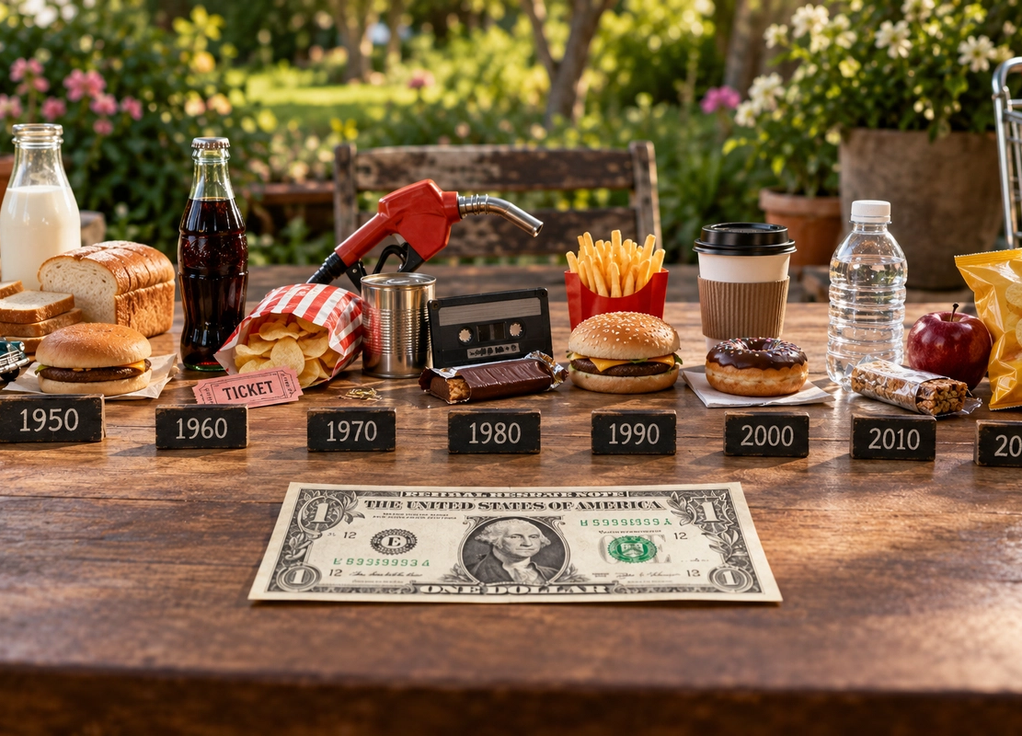
What a Dollar Actually Bought in Every Decade Since 1950
Alvin Cortes
September 9, 2026
A dollar has always been a dollar, but what you could actually do with one has changed dramatically.
In 1950, a single dollar could cover several everyday purchases. Today, it might not be enough for a bottle of water in some places. That difference is mostly the result of inflation, which gradually raises the general price level and reduces what each dollar can buy.
Historical prices also come with an important warning. Prices varied by location, brand and store just as they do today, so there was never one universal price for a hamburger, movie ticket or gallon of gasoline.
Still, looking at typical prices gives us a surprisingly vivid picture of how the purchasing power of one dollar changed across generations.
In the 1950s, one dollar went a long way
In 1950, the median American household income was only a few thousand dollars per year, but everyday prices were also dramatically lower than they are today.
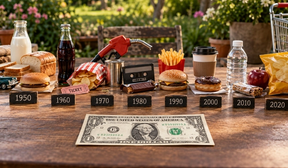
A gallon of gasoline could cost around 25 to 30 cents during parts of the decade. A loaf of bread could be under 20 cents. A movie ticket was often around 50 cents.
That meant a person carrying a dollar could realistically buy several ordinary things.
Fast food provides an especially memorable example. When McDonald’s began expanding its Speedee Service System in the 1950s, its famous hamburgers sold for 15 cents.
One dollar could theoretically buy six of them with change left over.
Of course, earning a dollar also required considerably more work than it does for most Americans today. Looking only at prices without considering wages makes the past appear cheaper than it really was.
In the 1960s, a dollar could still fund a small outing
A dollar remained meaningful pocket money throughout much of the 1960s.
Gasoline was commonly well below 50 cents per gallon. A movie ticket remained comfortably under a dollar for much of the decade, and many snacks and soft drinks cost only a few cents.
Children could walk into a store with coins and leave with several pieces of candy.
That is one reason older generations sometimes remember small amounts of money so vividly. A quarter wasn’t merely loose change. It could actually buy something.
However, inflation was beginning to accelerate toward the end of the decade.
The purchasing power of the dollar was already slipping.
The 1970s made inflation impossible to ignore
The 1970s changed Americans’ relationship with prices.
Inflation became a major economic problem, while the oil crises contributed to dramatic changes in energy costs.
At the beginning of the decade, a dollar could still buy multiple gallons of gasoline in some places. By the end, that was no longer realistic.
Food prices climbed too.
The psychological effect was important. Americans who had grown accustomed to relatively stable prices suddenly watched familiar products become noticeably more expensive.
A dollar still had significant purchasing power, but people could actually feel that power declining.
This is one reason the decade remains so closely associated with inflation. Rising prices weren’t an abstract economic concept.
People encountered them every time they visited a grocery store or gas station.
In the 1980s, the dollar became pocket change
By the 1980s, many purchases that once cost well below a dollar were approaching or passing it.
The average movie ticket moved beyond the dollar mark long before the decade began and continued climbing. Gasoline prices fluctuated significantly, at times costing more than a dollar per gallon.
Fast food was still inexpensive by modern standards, but a single dollar no longer bought the miniature feast it might have provided in the 1950s.
There were still plenty of things available for less than a dollar.
Candy bars, newspapers and small convenience-store purchases remained accessible with coins.
But the dollar was increasingly becoming one unit within a purchase rather than enough money to cover the entire transaction.
The 1990s gave the dollar menu a reason to exist
The 1990s created an interesting moment for the dollar.
One dollar was no longer much money, but it was still enough to function as a psychologically attractive price point.
Fast-food chains leaned heavily into value pricing. Items costing around a dollar felt cheap enough to buy without much thought.
A can of soda from a vending machine could still cost well under a dollar in many places early in the decade. Candy and small snacks remained possible purchases.
But major everyday expenses had moved far beyond it.
A movie ticket cost several dollars. A gallon of gasoline often cost more than a dollar. A normal restaurant meal required several dollars at minimum.
The dollar was becoming associated with bargains rather than ordinary prices.
The 2000s made one-dollar deals feel unusually cheap
During the 2000s, “only $1” became increasingly powerful marketing language.
Dollar menus expanded. Discount stores emphasized the price point. Products advertised for one dollar felt noticeably inexpensive.
That alone reveals how much things had changed.
In the 1950s, one dollar could buy multiple ordinary products. By the 2000s, finding something that still cost exactly one dollar was notable enough to advertise.
Small food items remained among the easiest examples. A fast-food burger, drink or snack could sometimes still be found around that price.
But the category was shrinking.
Inflation continued doing what inflation usually does: quietly making the same amount of money buy less.
The 2010s began saying goodbye to the dollar purchase
During the 2010s, even classic one-dollar purchases began creeping upward.
Vending-machine drinks increasingly cost more. Coffee from many chains was several dollars. Fast-food value menus shifted toward broader value categories instead of promising that everything actually cost one dollar.
Even dollar stores began facing pressure from rising costs.
Digital payments also changed how consumers experienced small prices.
When people paid with cash, the difference between 75 cents and $1.25 was physically obvious. With cards and smartphones, small purchases became less connected to specific coins and bills.
The dollar remained culturally important.
Its practical buying power was becoming increasingly limited.
By the 2020s, finding something for exactly one dollar became difficult
The inflation experienced during the early 2020s made the decline particularly visible.
Many products that people mentally remembered as costing a dollar suddenly cost two, three or considerably more.
Even Dollar Tree, famous for selling products at a fixed one-dollar price, raised its standard price point above one dollar.
Today, a dollar can still buy things, particularly individual grocery items, promotional products or very small quantities.
But in many everyday situations, handing someone a single dollar bill will not get you very far.
It is more likely to contribute toward a purchase than complete one.
A 1950 dollar and a modern dollar aren’t really comparable
This is where historical price comparisons can become misleading.
Seeing that a hamburger once cost 15 cents can make the past look unbelievably affordable.
But people also earned far less money.
A worker wasn’t receiving a modern salary and shopping at 1950 prices. Both wages and prices existed within a completely different economy.
Inflation calculators help demonstrate the difference. A dollar from 1950 represents roughly the purchasing power of many dollars today, although the exact comparison depends on the year and inflation measure being used.
So your grandparents were not living in a magical economy where houses cost almost nothing and everyone had enormous amounts of disposable income.
Their dollars were simply worth more.
The disappearing dollar tells the story of inflation
The most interesting thing about following one dollar through history is how gradually its role changes.
In the 1950s, it could pay for several purchases.
Later, it could pay for one.
Then it became the price of a bargain.
Eventually, it became part of the amount needed to buy something else.
That process feels strange because the bill itself looks basically the same. The number printed on it never changes.
Its purchasing power does.
That is why older people can sincerely remember buying things for prices that sound impossible today.
They weren’t necessarily living in a cheaper world.
They were spending a much more valuable dollar.