
The Real Difference Between the World We Grew Up In and the One We Live In Now
Ryker McGee
September 9, 2026
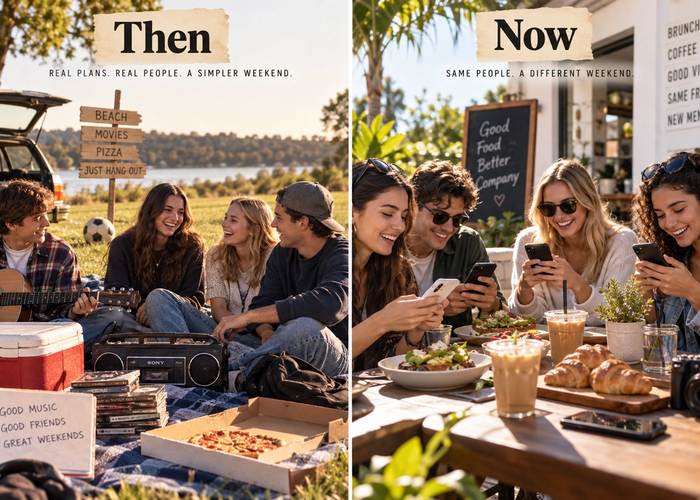
The world did not suddenly become modern one morning. It happened quietly, one ordinary convenience at a time.
Maps disappeared from glove compartments. Cameras disappeared from vacation bags. Phone numbers stopped being memorized. Television schedules became irrelevant. Waiting for someone who was late turned into watching their location move across a screen.
None of these changes seemed enormous individually. Together, they transformed everyday life.
For anyone who remembers growing up before smartphones and constant internet access, the biggest difference is not simply that technology improved. It is that uncertainty, boredom, privacy and distance used to be normal parts of life.
Today, we have eliminated much of that friction. We gained extraordinary convenience in the process, but everyday life feels fundamentally different because of it.
We used to be unreachable
There was a time when leaving the house meant becoming temporarily unavailable.
If someone called the landline while you were out, they could leave a message or try again later. Friends did not expect immediate replies because immediate replies were often physically impossible.
Parents might know that their children were “somewhere outside” without knowing their exact location.
Even adults routinely spent hours without anyone being able to contact them.
Mobile phones changed that gradually. Smartphones completed the transformation.
Today, being unreachable can feel unusual enough to require an explanation.
A message arrives and the sender can sometimes see whether it was delivered, opened or ignored. Work can follow employees home. Family members can share live locations.
We gained safety and convenience.
We also created the expectation that everyone should be available almost all the time.
Information used to have an ending
Before the internet, looking something up was an activity with boundaries.
You checked an encyclopedia. You visited a library. You asked someone who seemed likely to know.
Sometimes you simply did not find the answer.
Today, information is effectively endless.
A question that once might have remained unresolved for days can be answered before a conversation ends. If someone mentions an unfamiliar actor, restaurant or historical event, a phone can provide the answer within seconds.
This is an extraordinary improvement.
But information no longer stops when we have what we need.
One article leads to another. One video becomes twenty. A quick search can become an hour of unrelated browsing.
We solved the problem of not having enough information.
Then we created the problem of having no obvious point at which to stop consuming it.
Boredom used to be unavoidable
Boredom was once built into everyday life.
You waited in line with nothing to do. You sat in a doctor’s office and stared around the room. You took a bus and watched the scenery.
Children told their parents they were bored and received the deeply unhelpful response, “Find something to do.”
So they did.
Boredom pushed people toward books, conversations, daydreaming, wandering around or inventing games.
None of this means boredom was secretly wonderful. It was often extremely boring.
But smartphones almost completely removed it.
Any empty moment can now be filled instantly.
There is always a message, video, article, game, podcast or feed waiting.
We gained unlimited entertainment.
We lost many of the moments when our minds had absolutely nothing demanding their attention.
Photos went from rare objects to constant evidence
Family photography once involved relatively few pictures.
Film cost money. Developing it cost more money. You could take an entire roll on vacation and discover afterward that someone’s eyes were closed in half the photographs.
Because photographs were limited, they often felt important.
They went into albums, frames and boxes.
Digital cameras increased the number dramatically. Smartphones made photography constant.
Today, an ordinary dinner can produce more photographs than an entire family vacation once did.
The purpose changed too.
Photos were traditionally taken mainly to remember something later. Now they can also be communication happening in real time.
We photograph food to send it to someone. We photograph ourselves to post where we are. We record concerts while we are attending them.
We have never documented our lives more thoroughly.
Strangely, we may spend more time looking through the camera while the memory itself is being created.
Entertainment used to make us wait
If your favorite television show aired Thursday at 8 p.m., Thursday at 8 p.m. mattered.
Missing it could mean waiting for a rerun.
Music worked similarly. You waited for a song on the radio or saved money to buy an album. Movies had clear stages: cinema, rental, television.
Scarcity created anticipation.
Streaming removed most of those boundaries.
Entire television seasons can appear at once. Almost every song you might want is available immediately. Movies can be rented without leaving the sofa.
This is obviously more convenient.
But anticipation has become harder to manufacture.
Waiting a week for the next episode gave people time to discuss it. Buying an album made listening to it feel like an event.
Unlimited access changed entertainment from something we waited for into something waiting for us.
Our social worlds became much larger
Growing up, friendship was heavily influenced by geography.
You knew the children in your neighborhood because they were there. You became friends with classmates because you saw them five days a week.
Moving away could genuinely end friendships.
Today, distance matters much less.
Friends can message each other constantly across continents. Families separated by thousands of kilometers can video call for free. People with unusual interests can find communities containing thousands of others who understand them.
That is an extraordinary social change.
But larger networks can also make relationships feel more continuous and less defined.
We know what old classmates are doing without speaking to them. We see acquaintances’ vacations, marriages and children years after they disappear from our actual lives.
People no longer vanish from our social worlds as easily as they once did.
Mistakes became more permanent
Previous generations did embarrassing things too.
The difference was that fewer people were carrying cameras.
A stupid comment could disappear with the conversation. A terrible teenage haircut survived in a handful of photographs rather than hundreds. An awkward night out did not automatically generate video evidence.
The internet changed the lifespan of ordinary mistakes.
Posts can be copied. Photographs can circulate. Something intended for a small audience can suddenly reach thousands or millions of people.
This has created a strange new awareness of personal history.
Young people are not simply living their teenage years.
Some are creating searchable archives of them.
Convenience removed friction from almost everything
Perhaps the biggest difference between then and now is friction.
Getting lost created friction. Waiting for a taxi created friction. Finding a restaurant created friction. Buying something unavailable locally created friction.
Technology removed enormous amounts of it.
GPS tells us where to go. Ride-sharing apps find transportation. Online reviews help choose restaurants. Shopping platforms deliver products directly to the door.
This has made daily life easier in countless ways.
But friction sometimes produced unexpected experiences.
Getting lost could lead somewhere interesting. Searching through a record store could introduce you to music you were not looking for. Waiting gave strangers reasons to talk.
Efficiency is useful.
It is not always memorable.
We gained more than we lost, but we did lose something
It is easy to turn comparisons like this into nostalgia.
The old world was not automatically better.
People got genuinely lost. Long-distance communication was expensive. Finding information could be frustrating. Missing an important phone call mattered. Waiting was often simply annoying.
Technology solved real problems.
But every solution changed behavior too.
The biggest difference between the world we grew up in and the one we live in now may be that modern life gives us much more control.
We can control what we watch, when we listen, where we go, who we contact and what information we receive.
The old world contained more uncertainty.
Sometimes that uncertainty was inconvenient.
Sometimes it created surprise.
And perhaps that is why people remember it so fondly. We did not know what was coming next nearly as often.
We had to wait and find out.