The Leaders Who Defined Their Era (And What They Got Right)
Mekhi Gross
September 9, 2026
Great leaders are rarely remembered because they got everything right. Most made mistakes, faced criticism and left complicated legacies.
What makes certain leaders historically significant is that they understood something important about the moment they were living through. Some recognized that an old political system could no longer survive. Others knew when compromise was necessary, when public confidence mattered or when a crisis required an entirely new response.
Looking at what leaders got right does not require pretending they were perfect. In fact, their successes are more useful when separated from the mythology that often grows around famous political figures.
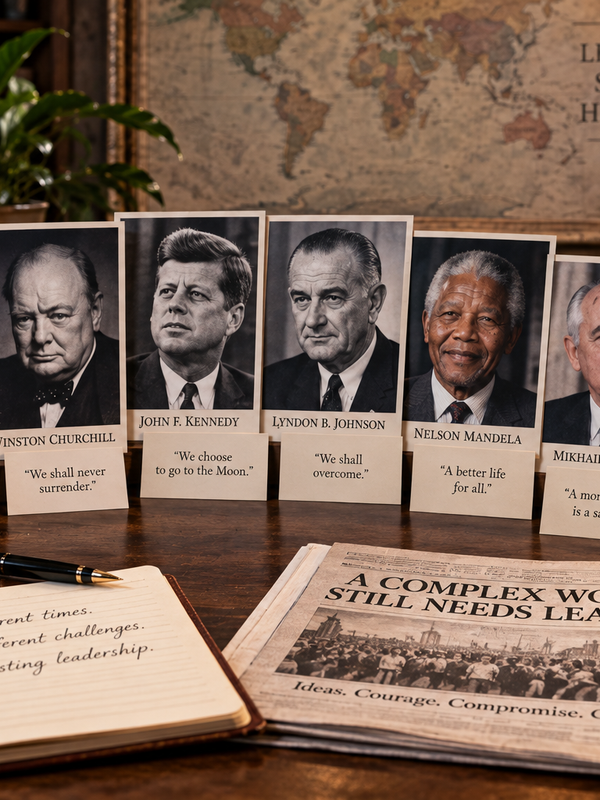
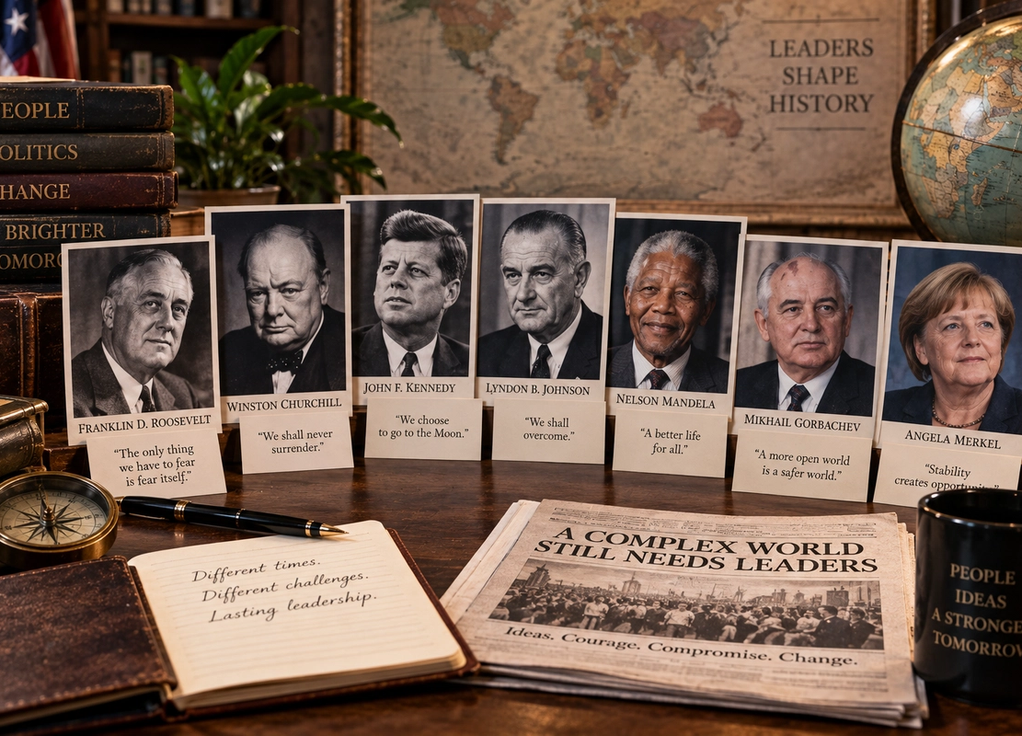
From Franklin D. Roosevelt to Nelson Mandela, certain leaders became inseparable from their eras because they responded to problems that seemed almost impossible to solve.
Franklin D. Roosevelt understood that confidence mattered
When Franklin D. Roosevelt became president in 1933, the United States was deep in the Great Depression.
Banks had failed. Unemployment was enormous. Families had lost savings, homes and confidence in the economic system.
Roosevelt’s response, known collectively as the New Deal, dramatically expanded the federal government’s involvement in economic life. Programs created jobs, strengthened financial regulation and established institutions that would remain important long after the Depression.
Not every New Deal policy worked as intended, and economists and historians still debate exactly how much the programs contributed to economic recovery.
But Roosevelt understood something crucial about the crisis.
Economic panic was also psychological.
His fireside chats used radio to speak directly to Americans in language intended to make complicated problems understandable. At a moment when trust in institutions had collapsed, communication became part of governing.
Winston Churchill understood the power of resolve
Winston Churchill became British prime minister in May 1940 under extraordinary circumstances.
Nazi Germany had conquered or was rapidly defeating much of Western Europe. France was collapsing, and Britain faced the possibility of standing largely alone against Hitler.
Churchill’s greatest contribution during this period was not a particular battlefield decision.
It was his refusal to present the situation as easier than it was.
His speeches acknowledged the scale of the danger while insisting that resistance remained possible. That combination mattered. Empty optimism would have sounded ridiculous. Defeatism could have been disastrous.
Churchill’s broader political record was far more complicated, particularly regarding empire and colonialism.
But his leadership during Britain’s most dangerous period of World War II became historically defining because he understood that national morale itself was a strategic resource.
John F. Kennedy understood the importance of ambition
John F. Kennedy’s presidency lasted less than three years, but his administration became closely associated with a particular idea of American possibility.
One of the clearest examples was the space program.
In 1961, Kennedy committed the United States to landing a person on the Moon and returning them safely before the end of the decade.
At the time, this was an extraordinary goal.
The Soviet Union had achieved major early successes in the space race, and the technology required for a lunar landing did not yet fully exist.
Kennedy’s decision created a clear national objective around which enormous scientific, industrial and financial resources could be organized.
Apollo 11 eventually reached the Moon in 1969, years after Kennedy’s assassination.
The achievement demonstrated what a specific, ambitious goal could do when backed by sustained institutional commitment.
Lyndon B. Johnson understood that political opportunity could disappear
Lyndon B. Johnson remains one of the most complicated American presidents.
The Vietnam War deeply damaged his presidency and dominates much of his historical legacy.
Domestically, however, Johnson understood congressional power exceptionally well.
After Kennedy’s assassination, Johnson used his political experience and the momentum of the moment to push major civil rights legislation through Congress.
The Civil Rights Act of 1964 prohibited discrimination in major areas of public life. The Voting Rights Act of 1965 attacked barriers that had prevented Black Americans from exercising voting rights.
Johnson also pursued his Great Society programs, including Medicare and Medicaid.
His presidency demonstrates something important about political leadership.
Having good ideas is not enough.
A leader also needs to recognize when there is an opportunity to turn those ideas into law.
Nelson Mandela understood that victory was not enough
Nelson Mandela emerged from 27 years of imprisonment to become one of the central figures in South Africa’s transition away from apartheid.
It would have been understandable for that transition to focus entirely on punishment.
Instead, Mandela emphasized reconciliation while still supporting the creation of a democratic political system based on equal citizenship.
This did not solve South Africa’s enormous inequalities, many of which remain.
Nor was the end of apartheid the achievement of Mandela alone. It resulted from decades of activism inside South Africa, international pressure, political negotiation and resistance by countless people.
Mandela’s particular achievement was understanding the danger of turning political victory into permanent revenge.
The country needed to dismantle an unjust system without creating an endless cycle of retaliation.
That required a form of leadership built around restraint.
Mikhail Gorbachev understood that the Soviet system needed reform
When Mikhail Gorbachev became leader of the Soviet Union in 1985, the country faced deep economic and political problems.
Gorbachev introduced policies associated with glasnost, or greater openness, and perestroika, economic and political restructuring.
His reforms ultimately produced consequences far beyond what he initially intended.
Political openness weakened the Communist Party’s control, nationalist movements gained strength and the Soviet Union eventually dissolved in 1991.
From the perspective of preserving the Soviet state, the outcome was clearly not what Gorbachev wanted.
But he also played a major role in reducing Cold War tensions and allowed political transformations in Eastern Europe to proceed without the massive Soviet military interventions seen in earlier decades.
Sometimes what a leader gets right produces results they never planned.
Angela Merkel understood the value of stability
Angela Merkel served as Germany’s chancellor from 2005 to 2021, an unusually long period that included repeated crises.
Her governments navigated the global financial crisis, the eurozone debt crisis, major migration pressures, Brexit negotiations and the early stages of the COVID-19 pandemic.
Merkel’s leadership style was rarely theatrical.
That was part of its appeal.
She became associated with caution, detailed negotiation and a willingness to delay decisions until she believed enough information was available.
Critics argued that this cautious approach sometimes postponed difficult structural decisions, particularly around energy, defense and economic policy.
Still, during periods of instability, Merkel understood that predictability could itself become a political asset.
Leadership does not always require appearing dramatic.
Sometimes people want the person in charge to make the situation feel manageable.
Good leadership depends on understanding the moment
There is no single leadership style that works in every crisis.
Churchill’s wartime rhetoric would be exhausting in ordinary politics. Merkel’s cautious incrementalism might have been poorly suited to Roosevelt’s emergency in 1933. Mandela’s emphasis on reconciliation responded to circumstances completely different from Johnson’s legislative battles.
That is what makes these leaders interesting.
Their strengths matched particular historical moments.
The most effective leaders often recognize what their situation requires before everyone else does.
Sometimes that means ambition. Sometimes it means compromise. Sometimes it means moving quickly while political opportunity exists.
And sometimes the most important decision is simply refusing to make a terrible situation worse.
History remembers leaders for enormous events.
What separates the defining ones is often their ability to understand what those events required from them.