The Video Game Consoles That Defined Every Generation
Mekhi Gross
September 8, 2026
Every generation of gaming has had one console—or sometimes a fierce rivalry between two—that seemed to define the era.
The hardware changed, obviously. Controllers gained more buttons. Cartridges became discs, discs competed with downloads, and graphics went from a handful of colored pixels to enormous photorealistic worlds.
But consoles have always been about more than specifications.
The most important systems changed what people expected from games. The Atari 2600 helped establish gaming at home. Nintendo revived a struggling industry. PlayStation made games feel older and cooler. The Wii convinced grandparents to play bowling. Modern consoles turned gaming machines into permanently connected entertainment platforms.
Looking back at their history is almost like looking at the evolution of gaming itself.
Atari brought the arcade into the living room
The Atari 2600 wasn’t the first home video game console, but it became one of the machines that established the idea that video games belonged in ordinary homes.
Released in 1977, it used interchangeable cartridges, allowing one console to play many different games. That sounds completely obvious now. At the time, it was transformative.
Players could experience versions of arcade hits such as Space Invaders and Pac-Man without leaving home.
The graphics were extremely simple by modern standards, but that hardly mattered. The important shift was behavioral: video games were no longer something you primarily encountered at an arcade.
Gaming could happen on the family television.
The enormous popularity of the Atari 2600 helped create the home-console business, even though the North American gaming market later crashed dramatically in the early 1980s.
That collapse opened the door for another company.
Nintendo made consoles feel essential again
When Nintendo released the Nintendo Entertainment System in North America in the mid-1980s, confidence in home video games was still recovering.
Nintendo helped change that.
The NES introduced millions of players to games and characters that would become permanent parts of popular culture. Super Mario Bros., The Legend of Zelda and Metroid demonstrated how much more ambitious console games could become.
Nintendo’s influence continued with the Super Nintendo Entertainment System.
By the 1990s, the rivalry between Nintendo and Sega became part of gaming culture itself. The SNES and Sega Genesis represented competing identities, with Mario on one side and Sonic the Hedgehog on the other.
Arguments about which console was better happened in schools, magazines and living rooms long before social media gave everyone a public place to continue them.
Console loyalty had arrived.
PlayStation changed who games were for
Sony entering the console market in the 1990s was a major turning point.
The original PlayStation arrived during the transition toward 3D gaming and embraced CDs instead of cartridges. That offered developers more storage while helping games incorporate larger worlds, extensive audio and cinematic sequences.
But PlayStation’s cultural impact went beyond hardware.
Sony marketed gaming in a way that appealed strongly to teenagers and young adults. Consoles no longer had to feel like children’s toys.
Games such as Final Fantasy VII, Metal Gear Solid, Gran Turismo and Resident Evil reinforced that change. Console gaming could be cinematic, strange, sophisticated and occasionally genuinely frightening.
Then came the PlayStation 2.
Released in 2000, the PS2 became enormously successful and doubled as a DVD player at a time when many households were adopting the format. Its massive game library helped make it one of the defining entertainment devices of the decade.
Xbox made online console gaming mainstream
Microsoft entered the console business with the original Xbox in 2001.
The machine had one enormous advantage: Microsoft understood networks.
Xbox Live helped normalize the idea that console players could easily compete and communicate online. Online gaming existed before Xbox, but Microsoft’s integrated service made it feel like a fundamental part of the console experience.
The Xbox 360 pushed that concept much further.
Games such as Halo 3 and the Call of Duty series helped make online multiplayer central to an entire generation of gaming. Friends didn’t necessarily need to be sitting on the same couch anymore.
They could be in different houses—or different countries.
That transition fundamentally changed console gaming. Today, online connectivity is so normal that a completely offline console can feel unusual.
The Wii proved that power wasn’t everything
In 2006, Nintendo did something unexpected.
Instead of trying to build the most powerful console, it released the Wii.
Its motion-sensitive Wii Remote allowed players to swing, point and move rather than relying entirely on traditional button combinations. The idea was immediately understandable, even to people who rarely played games.
Wii Sports became the perfect demonstration.
Suddenly, children were playing virtual tennis with their parents. Families were bowling together in living rooms. Consoles appeared in retirement homes and parties where nobody cared about frame rates or polygon counts.
The Wii demonstrated an important lesson: innovation didn’t always mean better graphics.
Sometimes changing how people interact with games matters more.
PlayStation 4 and Nintendo Switch reshaped modern expectations
By the 2010s, consoles had evolved into complete digital entertainment platforms.
Sony’s PlayStation 4 became one of the defining systems of the generation, supported by major games such as God of War, Horizon Zero Dawn and Marvel’s Spider-Man.
Meanwhile, Nintendo once again took a different approach.
The Nintendo Switch blurred the distinction between home and portable gaming. Players could use it on a television, remove it from its dock and continue the same game somewhere else.
That flexibility turned out to be enormously appealing.
Instead of asking players to choose between a handheld and a home console, Nintendo effectively said: why not both?
Today’s consoles are powerful, but generations feel different now
The PlayStation 5 and Xbox Series X|S represent astonishing advances compared with early consoles. Games load faster, worlds are larger, online services are deeply integrated and graphics can approach cinematic realism.
Yet console generations don’t feel quite as distinct as they once did.
Games increasingly launch across multiple generations. Digital libraries follow players between machines. Cross-platform multiplayer allows people on different hardware to play together. Subscription services provide access to large catalogs instead of requiring every game to be purchased individually.
The console itself is becoming one part of a much larger gaming ecosystem.
Still, every major generation left something behind.
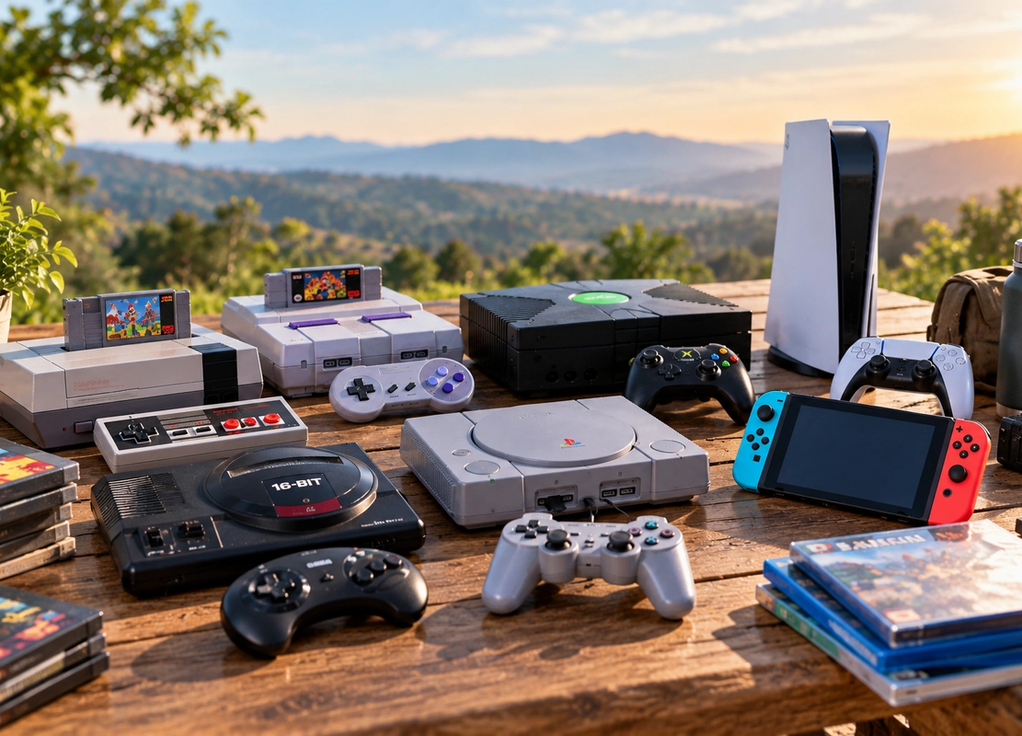
Atari established the living room. Nintendo built enduring gaming culture. PlayStation expanded the audience. Xbox pushed online play. Wii introduced motion gaming to millions. Switch erased the boundary between portable and home consoles.
The technology keeps changing.
But the consoles we remember most aren’t necessarily the ones with the best specifications.
They’re the ones that changed what we thought a video game console could be.