What Tech Looked Like in the ’90s (And What We Got Right)
Alvin Cortes
September 8, 2026
The 1990s occupy a strange place in technology history. They are recent enough that many of the devices feel familiar, but distant enough that using them today can seem almost prehistoric.
Computers were becoming household objects. The internet was beginning to connect ordinary people. Mobile phones existed, but calling someone from the street still felt vaguely futuristic. Video games were making the leap from simple 2D worlds to 3D environments. CDs were replacing cassette tapes, while DVDs were waiting around the corner.
Looking back, ’90s technology was slow, bulky, noisy and often frustrating. But the decade also established surprisingly accurate ideas about how we would eventually use technology.
The internet was slow, but the basic idea was right
For anyone who remembers dial-up internet, the sound of a modem connecting is probably permanently stored somewhere in their brain.
Getting online could take time, and once you were connected, nobody could use the same phone line without causing problems. Websites loaded slowly. Images appeared piece by piece. Downloading a single song could take longer than listening to an entire album.
Yet the fundamental promise of the internet was already clear.
People were joining chat rooms, participating in forums, sending email, building personal websites and meeting strangers with the same interests. Search engines were trying to organize an exploding amount of information. Online stores were beginning to demonstrate that people might actually buy things without visiting a physical shop.
The technology was primitive, but the behavior wasn’t.
Today’s social networks, online communities, messaging platforms and e-commerce sites are much more sophisticated versions of things people were already experimenting with in the ’90s. We correctly guessed that the internet would become a place where people communicated, learned, shopped and entertained themselves.
What we underestimated was just how much of our lives would eventually happen there.
Computers went from specialist equipment to household essentials
At the beginning of the decade, owning a personal computer wasn’t necessarily considered essential. By the end of it, a computer was increasingly becoming something families expected to have at home.
And those machines had personality.
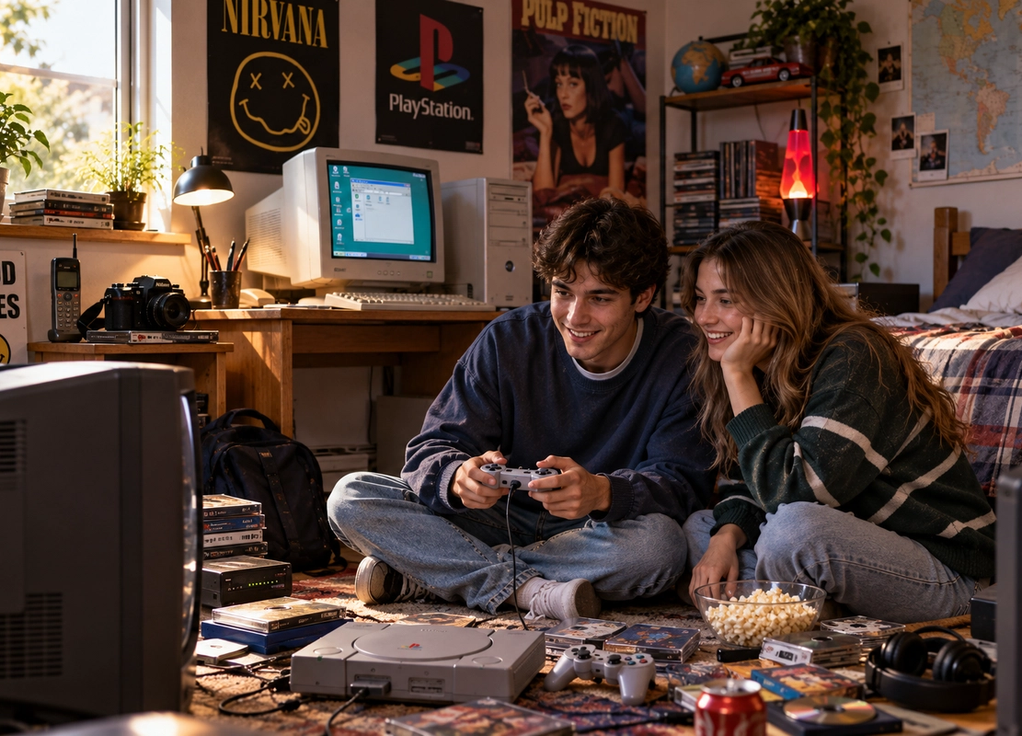
They came in large beige towers connected to enormous CRT monitors. Hard drives offered storage capacities that would be laughable today. Installing software often involved stacks of floppy disks or, later, shiny new CD-ROMs. A computer freezing wasn’t an unusual emergency. It was simply part of owning a computer.
But the ’90s got something important right: computers became general-purpose machines.
One device could be used for writing documents, playing games, doing homework, managing finances, editing pictures and accessing the internet. Instead of buying a different machine for every task, software could transform the same computer into whatever tool you needed.
That concept now sits at the center of modern technology. Smartphones took it even further, turning one pocket-sized device into a camera, map, music player, television, wallet, game console and communication system.
Mobile phones predicted an always-connected world
A ‘90s mobile phone wasn’t exactly elegant.
Early models were large, expensive and mostly designed for making calls. Battery life could be limited, coverage was inconsistent and texting only became widely popular later in the decade.
Still, mobile phones introduced a major cultural change: people could be reachable without being near a particular telephone.
Before that, calling someone usually meant calling a place. You called their house, office or hotel and hoped they were there. Mobile phones gradually changed the expectation. Instead of calling a location, you called a person.
That idea turned out to be enormously important.
The ‘90s didn’t give us today’s smartphone experience, but they established the assumption that communication should travel with us. Once that happened, smartphones were almost a logical next step.
Video games showed where digital entertainment was heading
The ’90s were transformative for gaming.
The decade began with consoles dominated by colorful 2D games and ended with players exploring increasingly ambitious 3D worlds. Nintendo, Sega, Sony and PC developers pushed gaming through enormous technological changes in only a few years.
More importantly, games were becoming experiences rather than simple distractions.
Titles such as Super Mario 64, Final Fantasy VII, Doom, Pokémon and The Legend of Zelda: Ocarina of Time demonstrated different possibilities for interactive entertainment. Games could create large worlds, tell emotional stories, encourage exploration, build communities and keep players invested for dozens of hours.
The graphics obviously look dated now, but many of the design principles established during the decade remain surprisingly recognizable.
Modern gaming’s obsession with immersive worlds, multiplayer communities, cinematic storytelling and recognizable franchises didn’t appear from nowhere. The ’90s provided much of the blueprint.
We imagined smart homes before we could really build them
The ’90s were also filled with optimistic visions of the “home of the future.”
Technology companies and television programs imagined houses where computers controlled lighting, entertainment, security and appliances. Some concepts were wonderfully ridiculous. Others were basically descriptions of products we now use every day.
The missing ingredient wasn’t imagination. It was infrastructure.
Internet connections weren’t fast or reliable enough. Sensors were expensive. Wireless networking was limited. Voice recognition was nowhere near ready for casual household use.
Today, smart speakers can control lights, robot vacuums map rooms, doorbells stream video to phones and thermostats automatically adjust temperatures. The futuristic house imagined in the ‘90s didn’t arrive exactly as predicted, but its basic idea certainly did.
The biggest prediction was that technology would disappear into everyday life
Perhaps the most accurate thing the ‘90s got right wasn’t a particular gadget.
It was the belief that digital technology would eventually become ordinary.
In the ’90s, “going online” was an activity. You sat at a computer, connected to the internet and eventually disconnected again. Taking a photograph required a camera. Listening to music meant choosing a cassette or CD. Watching a movie meant finding a television, cinema or video player.
Today, those boundaries have largely disappeared.
Technology isn’t something we occasionally use. It surrounds ordinary life so completely that we often stop noticing it.
The funny thing is that the ’90s imagined the future as being filled with futuristic gadgets. Instead, many of those gadgets merged into a handful of devices we carry everywhere.
The decade didn’t predict every detail correctly. But it understood the direction surprisingly well: more connected, more digital, more portable and increasingly impossible to separate from everyday life.